火柴人
又一起失联!23岁男子疑被绑至缅甸_我的网站

一 |
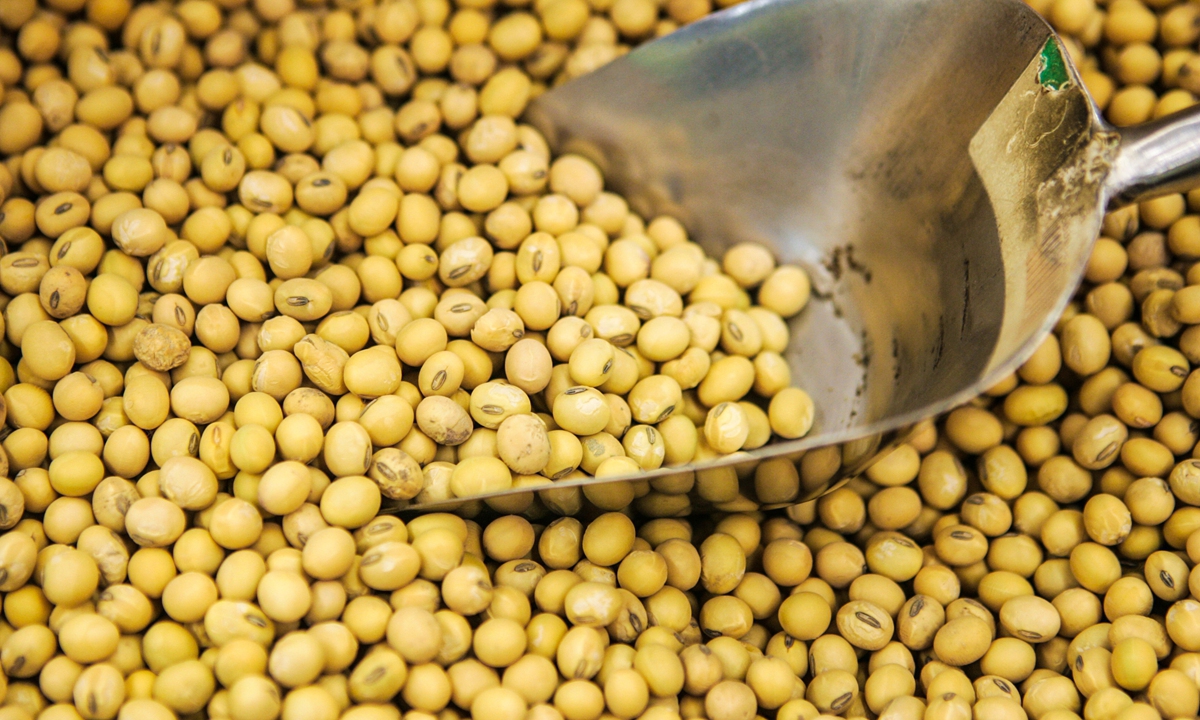
Soybean Photo: VCG
China continues to be the leading destination for Brazilian soybeans, and the Brazilian soybean industry wants to further deepen this relationship, expecting historically high volumes in the coming months, the Brazilian Association of Soybean Growers (Aprosoja Brasil) told the Global Times on Friday.
Brazilian soybean exports to China have remained very strong. China imported 12.08 million tons of soybeans from Brazil in June, up 13.7 percent year-on-year, while imports from the US fell 20.9 percent year-on-year to 1.27 million tons, according to data from the General Administration of Customs.
China imported 34.75 million tons of soybeans from Brazil during the period, up 9.1 percent year-on-year, according to Aprosoja Brasil. "Based on arrivals and customs clearance in China, there was clear growth," the association said.
According to the official data platform Brazilian Comex Stat, which records shipments at origin, 48.32 million metric tons were destined for China from January through June, largely unchanged from 48.41 million metric tons during the same period in 2025.
The difference between the two datasets mainly reflects timing and methodological differences between the recording of departures, cargoes in transit, arrivals and customs clearance.
Aprosoja Brasil said that the broader economic conclusion is the same: "Trade flows remained historically strong, China continued to be the leading destination for Brazilian soybeans, and Brazil's total soybean exports reached a first-half record of 69.57 million metric tons."
For farmers, strong export volumes help support the marketing of the crop, although record exports do not automatically mean record farm margins, said the Brazilian industry association.
China is the world's largest soybean importer. Imported soybeans are mainly used for oil production and animal feed. In terms of trading partners, China mainly imports soybean-related products from Brazil, the US, Argentina, Uruguay and Canada.
Brazil ranks among the world's leading soybean producers and exporters, with China being its largest export market for soybeans, according to the Xinhua News Agency.
Commenting on the significance of the Chinese market, Aprosoja Brasil said "China is absolutely strategic to Brazil's soybean industry," citing data showing that in 2025, China purchased 85.4 million metric tons, representing approximately 79 percent of all Brazilian soybean exports.
The two countries also have a highly complementary trade relationship. For Brazilian farmers, Chinese demand provides scale, market liquidity and greater capacity for long-term planning, said the Brazilian soybean industry association. For China, Brazil offers large, competitive and reliable supplies, as well as a crop calendar that complements production in other supplying countries.
Previously, policy shifts, such as US unilateral tariff measures, have caused disruption for US soybean farmers and other agricultural producers, Lü Xiang, research fellow at the Chinese Academy of Social Sciences, told the Global Times.
At the same time, China has been diversifying imports, including from Brazil and Argentina, to reduce risks from trade uncertainty, according to Lü.
Aprosoja Brasil noted that this partnership should not be seen merely as a temporary consequence of trade disputes involving third countries. Instead, it is a structural and mutually beneficial relationship, based on the complementarity between Brazil's production capacity and China's large demand for food, animal feed and protein, the industry group said.
Looking ahead to the soybean trade for the rest of the year, Aprosoja Brasil said that they are positive, while having a prudent mindset. Brazil has completed the harvest of a record soybean crop of approximately 180.6 million metric tons, and Brazilian soybean exports are expected to reach 116.3 million metric tons in 2026, which would also be a record, the association said.
"Brazil therefore has sufficient supply to continue serving the Chinese market strongly in the coming months... We expect historically high volumes, although not necessarily growth every single month, because soybean trade is seasonal and Northern Hemisphere supplies become more prominent during the second half of the year," it said.
。

二 | “中国船员疑抵泰国后失联被绑至缅甸”一事近日持续引发关注。1月6日,距离最后一次联系到弟弟小宇(化名)已经过去10天,来自河南商丘的李女士称,据当地警方调查以及向郑州新郑机场确认,2024年12月26日晚,小宇从郑州新郑机场登机,乘坐泰国皇雀航空DD3137次航班飞往泰国曼谷,于当地时间2024年12月27日凌晨2时许落地曼谷廊曼机场。不久后,小宇便失踪了,手机关机、微信不回,至今仍未能取得联系。李女士介绍,弟弟小宇今年23岁,是一名海船水手,这一次离家是因为有出海任务。小宇的相关证件信息。图源:中国海事局官网李女士说,这一次小宇出发也比较匆忙,没有具体告知去哪,只说等老板订好票就走,“甚至没有带什么行李,只拿了一身衣服和船上的工作服。”小宇落地泰国后,李女士还特意询问他这次出发为何没有带上厚衣服,小宇语音回复说:“穿不住(到),这地方热。” 这条语音也成了小宇发给李女士的最后一条消息,之后就一直失联。李女士与小宇的聊天记录。受访者供图2024年12月30日晚,一名陌生男子主动加微信联系李女士,向她发来小宇的照片和一段小宇被殴打的视频,“对方说我弟已经被绑到了缅甸,要我们支付10万元赎人,不然一辈子都别想见到我弟弟了。”李女士这才意识到事情的严重性,当天夜里就赶到派出所报警。陌生男子向李女士发来疑似小宇遭绑架的图片。受访者供图李女士怀疑,弟弟极有可能是被他人骗出国的。在该陌生男子与李女士的聊天记录中,他曾发来小宇的一张照片,上面附有泰文字样的文字信息。李女士通过翻译软件查询看到,拍摄时间显示为2024年12月27日,地点则为泰国湄索县——泰缅边境附近,“我弟弟就是在这一天之后开始失联的,不确定他人是不是已经到了缅甸境内被控制。

三 | ”李女士还透露称,在后续的聊天中,陌生男子多次提到了“人在缅甸”“KK园区”等信息。陌生男子与李女士的聊天记录。受访者供图目前,该事件有了最新进展。李女士已经拿到商丘市公安局睢阳分局出具的《立案决定书》,警方表示将针对李女士被敲诈勒索案展开进一步侦查。商丘市公安局睢阳分局出具的《立案决定书》。受访者供图李女士透露,接下来她将考虑前往泰国求助中国大使馆的帮助, “我之前从来没出过国,刚去办了护照,准备买机票去泰国。

四 | ”来源:新民晚报、封面新闻报料、维权通道:应用市场下载“晨视频”客户端,搜索“报料”一键直达;或微信添加报料客服:xxcbcsp;或拨打热线0731-85571188。如需内容合作,请拨打政企服务专席19176699651。
Current article:http://aw9sx.zeitujiangshaopen.pics/aw9prti/z1pmmq.html
Published on:11:13:39